Why a Historical Artist of America Association?
To revive, through annual exhibition, the art of historical illustration. It was practically wiped out when weekly periodicals, and publishers of fiction, ceased to include illustrations in their publications; and Fine art Illustration became principally an advertising tool.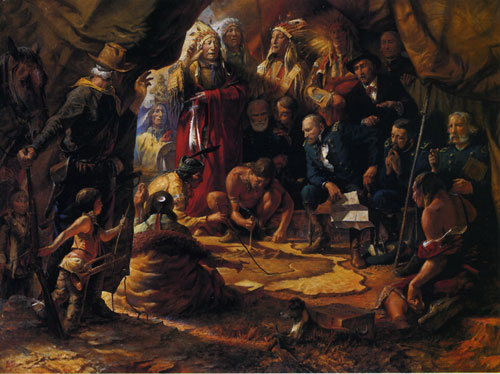
The question that keeps coming up: What kind of artists, make up the Historical Artists of America Association?
A historical artist is a visual reporter and a storyteller rolled into one. Someone who pictorially answers the questions which all of us have when we read or hear about a recent or ancient event. One who is able to orchestrate objects and figures on canvas with imaginative verve and historical integrity. See Bill Ahrendt’s painting “Fort Laramie Treaty of 1868”on the right. Or Tom Lovell’s below“Pecos Pueblo 1500”. These fine art illustrators visualized, composed, staged and even cast all the characters and directed them to portray, not just to what it was like to be there when it happened, but to “meet” the people who instigated and/or participated in the event.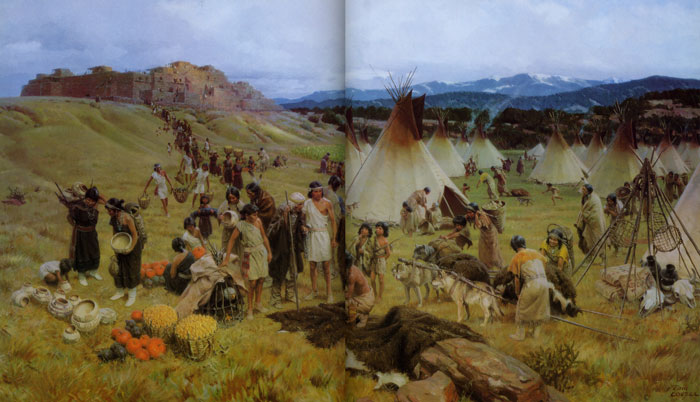
You keep using “fine art illustrators” to describe
these artists. What is the difference?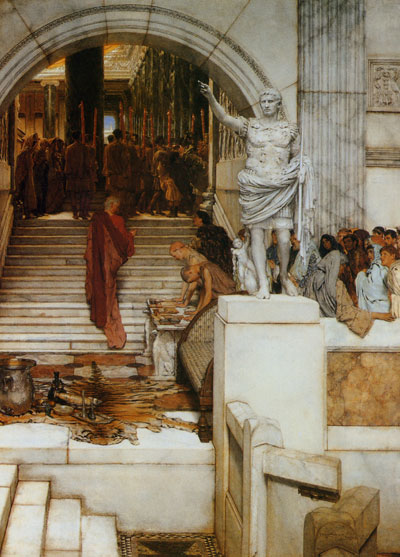
Are art schools preparing future artists to handle this type of self imposed or given assignment?
Yes, those which teach drawing based on the European classical principles. Take for example these two paintings from Lawrence Alma-Tadema: “The Death of the First Born” and “After the Audience.” Both these painting display a mastery of handling Line, Shapes, Value, Texture and Colors in a manner that, you the viewer, can’t help but believe that you were there.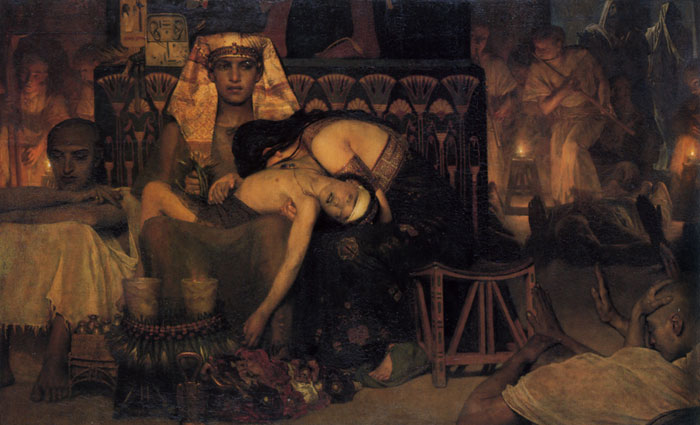
In your letter of 2.25.97 you reference the Association’s uniqueness and brand character as the strength of the membership that guarantees the permanence and continued value of the paintings as a sound investment.
That’s right. As in advertising, the creative content is usually not the effort of any one individual, but the result of several contributing creatively to a specific goal. It’s true that an individual usually begins the process by expressing an idea inspired by a specific need or event. But, whatever the idea, it can, in most cases, be improved through group synergy. Or as my ad tutor used to say, “ A plant grows better when it’s transplanted.” That will be the strength of the group and not just the individual ability of its members. To this end, although we each work at our own studios, we have scheduled sessions where we come together to critique each other’s thumbnails, studies and finally our paintings. We are even willing to call outside expertise to accomplish what is needed. And ultimately, that willingness to work with others is the group’s strength.
So how do you prepare for your first yearly exhibit?
We started by selecting Oregon’s history as a theme. Each of us selected a period or even individual events to illustrate. After the proper research we met to critique and/or offer suggestions about each other’s thumbnail sketches. This was largely the strength of the CA’s (Cowboy Artist of America) exhibit and sale. We go however a step further: we meet periodically to paint together and share creative and technical experiences. Always with an eye to further our talents and consequently the product.
Where does most of your material originate?
Primarily, in this case, from the Oregon’s Historical Society in Portland, newspapers, and other archival institutions. And often, also from people’s memories who’s ancestors past on to them.
There is room, however, for the members to imagine situations that were plausible given the
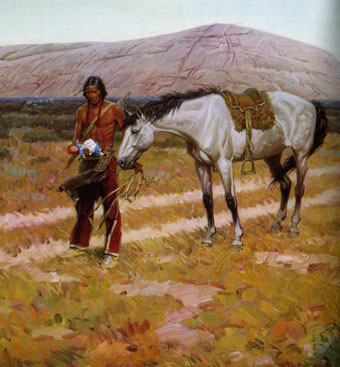
chronological facts and which are not included in history books. For example this painting by Tom Lovell of a Sioux brave finding a Raggedy Ann doll accidentally dropped. One can only imagine what the finder was thinking, and the little girl’s disappointment not being able to find her traveling companion. These stories, I think, round-out the human experience in my book.